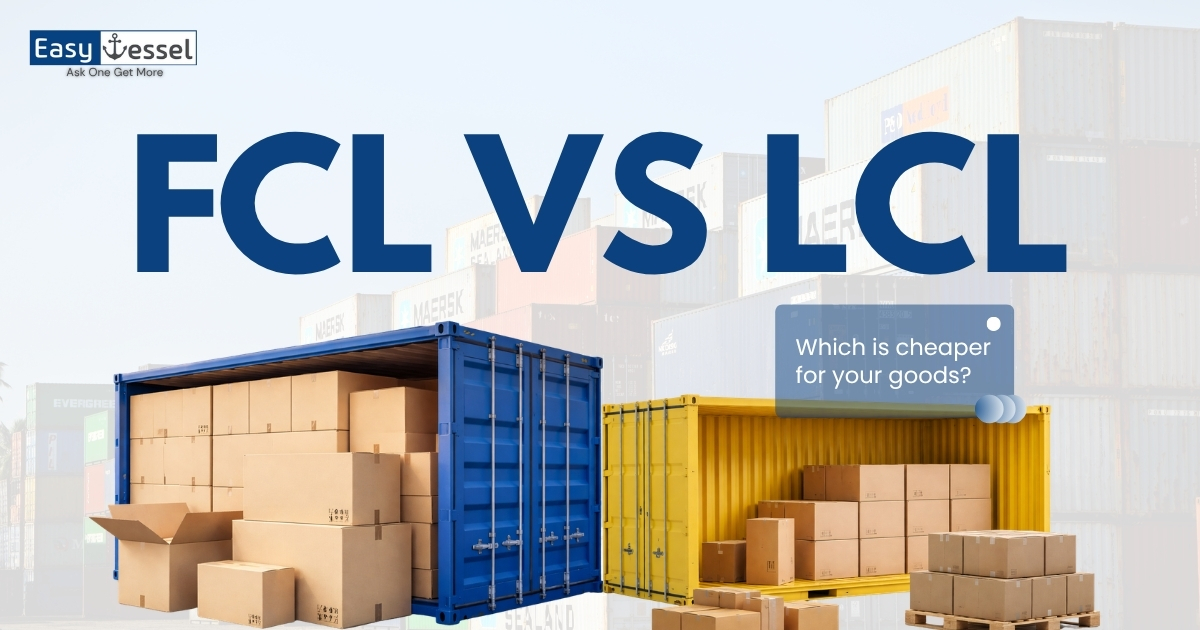
Shipping costs can quietly eat into your profit margins if the right decisions are not made at the right time. One of the most critical choices businesses face is FCL vs LCL, which is cheaper, especially when dealing with international shipments.
Whether you are shipping goods occasionally or managing regular export volumes, selecting the wrong option can increase your overall logistics cost without you even realizing it. At first glance, LCL may seem more affordable because you only pay for the space you use, while FCL looks expensive due to full container booking.
However, the real cost depends on factors like shipment volume, handling charges, transit time, and risk, which many businesses often overlook.
What is FCL (Full Container Load)?
FCL, or Full Container Load, means you are paying for the full container, whether you use all of it or not. The container is booked under your shipment alone, sealed at the origin, and opened only at the destination.
This creates a very controlled movement of goods. There are no intermediate stops for mixing cargo, no repeated handling, and no dependency on other shipments.
In real operations, FCL shipments are more predictable. Once the container is loaded, it moves through the system without waiting for additional cargo. This direct movement reduces both time and uncertainty.
For businesses that ship regularly or deal in bulk quantities, this predictability often translates into better planning and fewer unexpected costs.
How FCL Works
- You book a full container (20ft or 40ft)
- Cargo is loaded and sealed at the origin
- Container moves directly to the destination port
- Unloading happens only once at the delivery point
When FCL is Commonly Used
FCL is preferred when businesses ship large volumes, fragile goods, or high-value cargo, where safety and speed are important.
What is LCL (Less than Container Load)?
LCL, or Less than Container Load, works on a shared model. Your cargo is first sent to a warehouse where it is combined with shipments from other businesses. Once enough cargo is collected, a container is filled and shipped.
At the destination, the process is reversed. The container is opened, shipments are separated, and then delivered individually.
While this allows smaller shipments to move without booking a full container, it introduces multiple stages where costs and delays can occur. Each step—consolidation, storage, handling, and separation—adds both time and expense.
This is why LCL often looks cheaper at first but can become expensive when all charges are included.
How LCL Works
- Your cargo is sent to a consolidation warehouse
- Multiple shipments are combined into one container
- At the destination, the cargo is separated again
- Final delivery happens after deconsolidation
When LCL is Used
LCL is ideal for small shipments, trial orders, or businesses testing new markets without committing to large volumes.
Key Differences Between FCL and LCL
The Real Cost Difference Between FCL and LCL
To understand which option is cheaper, you need to look at how pricing is structured.
FCL pricing is straightforward. You pay a fixed rate for the container. This cost remains almost the same regardless of whether the container is fully utilized or partially filled. As a result, the more cargo you load, the lower your cost per unit becomes.
LCL pricing is more complex. Charges are calculated based on volume or weight, along with multiple service fees. These include handling, consolidation, documentation, and warehouse usage.
This is where the key difference appears.
For small shipments, LCL is usually the cheaper option because you are only paying for the space you use. But as your shipment grows, the cost increases proportionally. At a certain point, the total LCL cost becomes higher than booking a full container.
In most trade routes, this break-even point falls between 10 and 15 cubic meters. Beyond this range, FCL often becomes the more economical choice.
The Break-Even Point
In most cases:
- If your shipment is below 10–12 CBM, LCL is cheaper
- If your shipment is above 12–15 CBM, FCL often becomes more economical
This is because LCL includes additional costs like consolidation, handling, and documentation fees that add up quickly.
Real Scenario
Imagine:
- LCL rate: charged per CBM with added handling fees
- FCL rate: fixed container cost
As your shipment size increases, the per-unit cost in LCL rises faster than FCL. This is where many businesses unknowingly overspend.
To get a clear cost comparison tailored to your shipment, platforms like Easyvessel help businesses evaluate freight options based on real-time logistics data instead of assumptions.
Hidden Costs That Change the Final Price
One of the biggest mistakes businesses make is ignoring hidden costs, especially in LCL shipments.
In LCL, charges are not limited to freight. There are additional fees at both origin and destination. These include cargo handling, warehouse storage, container unpacking, and service charges.
These costs are often variable and depend on port conditions, shipment size, and timing. This makes LCL pricing less predictable.
FCL, on the other hand, has fewer variables. Since the container is handled as a single unit, there are fewer service stages involved. This reduces the chances of unexpected charges.
When you compare total landed cost instead of just freight rates, the difference between FCL and LCL becomes much clearer.
Transit Time: Which One is Faster?
FCL shipments usually move faster because they go directly from origin to destination without waiting for other cargo.
LCL shipments take longer due to:
- Consolidation delays at the origin
- Waiting for container filling
- Deconsolidation at destination
For time-sensitive shipments, delays in LCL can indirectly increase costs through missed deadlines or stock shortages.
Risk and Cargo Safety Comparison
Cargo safety is often overlooked in cost discussions.
FCL Advantage
- Container remains sealed
- Minimal handling
- Lower risk of damage or loss
LCL Risk Factors
- Multiple loading/unloading points
- Mixing with other cargo
- Higher chances of damage
If your goods are fragile or high-value, FCL can actually save money by reducing risk.
When FCL Becomes the Smarter Choice
FCL is not just for large companies. It becomes a better option whenever your shipment reaches a volume where per-unit cost starts decreasing.
It is especially useful when:
- Shipment size is close to container capacity
- Goods require careful handling
- Delivery timelines are strict
- You want predictable logistics costs
In these situations, FCL often provides better value despite higher upfront pricing.
When LCL Still Makes Sense
LCL remains a practical option for smaller shipments. It allows businesses to move goods without waiting to accumulate large volumes.
It is commonly used when:
- Shipment size is small
- Cash flow needs to be managed carefully
- New markets are being tested
- Inventory requirements are limited
However, businesses that continue using LCL as they grow often end up paying more than necessary.
This is why regular cost evaluation using a system like Easyvessel becomes important to decide when to shift from LCL to FCL.
Conclusion
The answer depends on your shipment size. For smaller volumes, LCL works well. But as your cargo grows, FCL quickly becomes more cost-effective, safer, and faster.
The smartest approach is not guessing, but calculating. Businesses that rely on accurate freight comparisons and real data make better shipping decisions and protect their margins.
If you want to compare FCL and LCL costs accurately and choose the most efficient shipping method for your goods, Easyvessel provides a practical way to evaluate your options and avoid unnecessary logistics expenses.
FAQs
At what volume does FCL become more economical?
In most cases, shipments above 12 CBM start favoring FCL due to lower per-unit cost.
How is the LCL cost calculated?
LCL cost is calculated based on volume (CBM) or weight, along with additional handling and service charges.
Which option is safer for the goods?
FCL is safer because the container is sealed and handled less frequently.
Can I switch from LCL to FCL later?
Yes, many businesses start with LCL and move to FCL as their shipment volume increases.